
What to Expect on Your First Visit to Primal Archery
“Will I hit the target?”
That’s one of the first things many new archers want to know.
The honest answer is: probably.
It might not be the centre, and your first arrow may go somewhere completely different from where you thought you were aiming, but most people are surprised by how quickly they can get an arrow safely downrange.
Archery can feel a little strange at first. You’re using unfamiliar muscles, holding equipment you may never have touched before, and trying to remember several new movements at once.
That doesn’t mean it’s too hard for beginners. It just means your body and brain are learning something new.
What happens when you first arrive?
When you arrive at Primal Archery, we’ll fit you with your equipment before you head to the practice range.
We’ll ask whether you’d prefer to pull the string with your right or left hand and give you a bow that should feel comfortable to use. You’re not locked into that decision. If something isn’t working during practice, we can adjust your technique, help with your aiming or let you try shooting from the other side.
Some staff members will even let you choose the colour of your arrows.
Luke’s approach is generally that you get what you get and you don’t get upset. He’s not a monster, though if you ask for a particular colour, he’ll usually give it to you. He just won’t ask first.
Once you have your equipment, we’ll give you a scorecard and ask you to read through the course rules. Then you’ll head over to the practice range for your coaching.
What happens during beginner coaching?
Your coach will begin with a short safety introduction and show you how to load, draw and release the bow.
We also have two demonstration bows that were broken by being dry fired. Showing people the actual damage tends to work better than simply telling them that it’s bad for the bow.
Depending on the group, your coach may demonstrate the whole process first or ask someone to be the model. I usually prefer using someone from the group so I can talk them through each part of the shot while everyone else watches.
We then go through one person at a time. Each person shoots all their practice arrows while the coach watches, gives individual feedback and makes sure the equipment feels right.
Once everyone has finished, we walk down to the target together. We’ll show you how scoring works, how to remove your arrows safely and where to find the beginning of your course.
For a group of around six people, this usually takes about 10 to 15 minutes. Some groups fly through it. Others need a second round before they’re ready to head out.
We’d much rather spend another few minutes helping you at the practice range than send you onto the course feeling confused.
“Uhh, how do I let go?”
You’d think letting go of the string would be the easiest part of shooting a bow.
Initially, it isn’t.
We break the shot down into small steps. Hook your fingers onto the string, pull your hand back towards your face and keep your elbow pointing behind you (roughly in line with the arrow). Keep your hand firm against your face and, when you’re ready, let go.
This is usually the point where someone asks:
“How?”
Once the string is under tension, your brain suddenly becomes very interested in what’s about to happen. Is it going to hurt? What will the release feel like? What if the arrow misses completely?
There’s already enough going on, so I usually don’t ask people to worry much about aiming on their first shot.
I just want that first arrow safely downrange.
Once you know what it feels like to release the string, we can start working on where the arrow goes.
What if I miss?
You probably will at some point. Everyone does!
Our practice range is built almost like a wooden tunnel, so if you panic, flick the string or send the arrow somewhere unexpected, the range contains the shot. You’re not going to send an arrow into the car park or towards another group.
That gives you a safe place to work out what the bow feels like without every shot needing to be perfect. It’s good to experiment - what works for me, might not work for you.
Most beginners are thrilled just to hit the target. We’re not standing behind you waiting for every arrow to land in the gold.
At this stage, we’re checking that you can use the bow safely, that the equipment feels right and that enough of your arrows are landing in the target for you to enjoy the course.
If your arrows still aren’t going where you expect, we’ll help work out why.
What if my arrows keep going in the wrong place?
There can be a lot of reasons.
Eye dominance is a common one. You may be pulling the string with one hand while your opposite eye is trying to take over the aiming. That can put your arrows somewhere very different from where you thought they should go.
Nerves can also make a big difference. Someone may shoot well on their first round and then start thinking so hard about every movement that their whole shot changes.
Sometimes people are simply trying too hard. Archery usually works better when the movement is controlled and repeatable, rather than forced.
It can also be the equipment.
Our bows and arrows are used hundreds of times. We maintain them regularly, but equipment can be knocked, adjusted or affected by the person who used it before you. If something doesn’t look right, we may swap your bow or arrows and see whether that changes the result.
The point of practice isn’t to judge whether you’re naturally good at archery. It gives us time to work out what’s happening and help you fix it before you go onto the course.
What is dry firing?
Before you get your gear the first thing you’ll hear at Primal Archery is:
“Please don’t pull the string back unless an arrow is loaded.”
It’s written on our signs. It’s on your scorecard and yes, we will say it again at the practice range.
Pulling and releasing the string without an arrow is called dry firing. At our park, we also ask that you don’t do any test pulls without an arrow loaded. You may know that you’re only testing the weight and plan to lower the string gently, but a child watching may only see you pull the bow back and assume it’s safe to copy.
Dry firing can damage the bow, hurt the archer and sometimes cause damage that isn’t immediately obvious. That means the bow could fail when the next person uses it.
If someone dry fires a bow, we remove it straight away so it can be properly inspected.
It’s one of the few mistakes we take very seriously.
You’ll also learn how to carry your equipment, when it’s safe to collect your arrows and how to remove them from the target without damaging them or accidentally hitting the person standing beside you.
None of the rules are complicated. Most of them are common sense, but they do matter.
Do you need to be strong to try archery?
No - not when you’re first starting!
One of the biggest misconceptions in archery is that a heavier bow automatically makes you a better archer.
It doesn’t.
A heavier bow doesn’t make you a better archer. It mostly makes your mistakes harder to control.
Now there’s nothing wrong with shooting a stronger bow once you’ve developed the technique and control to use it properly.
But most visitors are here for a casual shoot. They want to flick arrows downrange, have fun and try something different.
They’re not training for the Olympics.
We usually begin people with a comfortable, lower-powered bow so they can focus on learning the movement without fighting the equipment.
Stronger rental bows are available for people who genuinely need or want them, but good form matters far more than draw weight.
How do we know you’re ready for the course?
We’re not expecting every arrow to land in the target before we send you out.
Some people want detailed coaching and are determined to improve every shot. Others are perfectly happy to send a few arrows downrange, laugh at the misses and enjoy the course with their family.
Both are absolutely fine with us.
What we’re really checking at the practice range is that you can use the bow safely, follow the instructions and handle your equipment with enough control to move around the course.
If you’d like more help with your accuracy, just ask. We’re happy to give you extra tips, run through another practice round or help work out why your arrows aren’t going where you expect.
If you’re shooting safely and you’re comfortable heading out, we don’t need every arrow sitting neatly in the target. We’re not grading you on accuracy.
Can children, older adults and people with disability try archery?
Our minimum age is six years old, and children generally need to be around 120 centimetres tall.
The height requirement matters because a target bow can be awkward to manage if a child is too small. Kids all develop differently, though, so if you’re unsure, we’re happy to let them have a quick check before you pay.
The same sort of flexibility applies at the other end of the age range.
Sometimes Nanna doesn’t want to walk an entire course, but she’d still love to shoot one or two arrows at the practice range. I genuinely love those moments! Someone may be trying archery for the first time in their life, and they’ve chosen to do it with us.
We’ve also worked with wheelchair users, people with missing fingers or part of an arm, and people with intellectual disability.
We don’t assume archery will look exactly the same for everyone. We experiment, work out what’s comfortable and involve parents, family members or carers where hands-on help is needed.
We can’t promise that every activity will suit every person, but we’ll always be honest and do our best to find a safe way for someone to have a go.
What if I start struggling halfway around?
Come back and talk to us!
People sometimes shoot well during practice and then suddenly struggle once they’re halfway around the course. They may be getting tired, slipping into a bad habit or using equipment that no longer feels quite right.
You haven’t necessarily forgotten how to shoot - in fact, it’s likely you’re now overthinking it!
We can have another look, offer some extra coaching or swap your bow and arrows if needed. You can also call the shop if you’re out on the course and where possible, someone will come out to help.
We don’t want you to spend the rest of your visit getting increasingly frustrated.
Should I choose three arrows or six?
Our most popular option is the Woods course with three arrows.
For a casual family visit, three arrows per target is enough for most people. You’ll also learn quite a bit while watching the rest of your group shoot and listening to the advice your coach gives them.
Personally, I prefer the Woods with six arrows.
Six arrows gives you more time to settle in, experiment with the tips you’ve been given and recover from the occasional terrible shot without feeling like you’ve wasted a whole target.
You don’t need six arrows to enjoy archery, but it’s the option I’d choose for someone who wants the best introduction rather than simply the quickest one.
So, is archery hard for beginners?
It can feel awkward for the first few shots.
Letting go of the string may be much more confusing than expected. Your first arrow might miss. You may need to change bows, swap hands or be reminded to stop trying quite so hard.
That’s all normal.
You don’t need to arrive with experience, perfect eyesight or impressive upper-body strength. You just need to pay attention to the safety instructions and be open to learning.
For us, a successful first visit isn’t someone shooting a perfect score.
It’s someone finishing the course and having fun.
We love seeing people hit the centre, but what really tells us we’ve done our job is when they return the next day or the next week because they genuinely enjoyed themselves.
Ready to give archery a try?
The Woods with three arrows is our most popular beginner option and includes ten targets through the shaded course.
For a little more time to practise and experiment, the Woods with six arrows is my personal favourite.
Your visit includes equipment hire, beginner coaching and time at the practice range before you begin.
You don’t need to know what you’re doing yet. That’s what the practice is for.
About the author
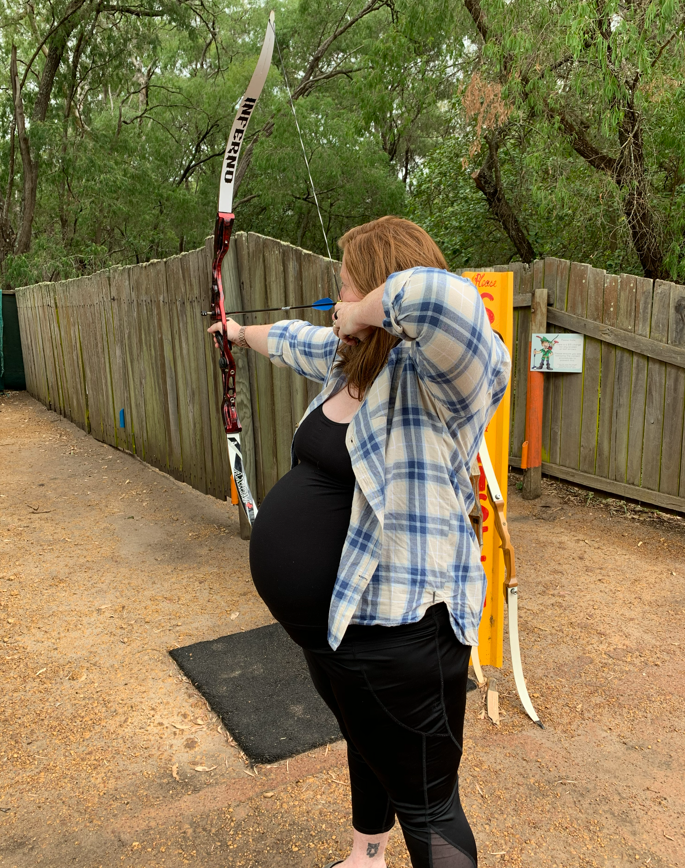
I’m Cassie, co-owner of Primal Archery in Busselton. Luke and I took over the park in 2018 after a decade of visiting and shooting here ourselves. I love shooting barebow and have spent the past eight years coaching beginners alongside Luke and the rest of our team, helping first-time archers feel more comfortable with a bow.
I genuinely enjoy working out why someone’s arrows aren’t going where they expect. My favourite part is watching something suddenly click, especially when one small adjustment sends the next arrow straight into the middle.